
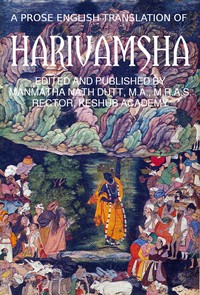
A Prose English Translation of Harivamsha by Manmatha Nath Dutt
So, the main event is over. The Kurukshetra war from the Mahabharata has ended, with all its tragedy and triumph. The Harivamsha picks up right there, but it quickly spins into something much bigger. It's split into three main sections. First, it deals with the aftermath—how Yudhishthira rules, and a final, eerie conflict that arises when the surviving warriors let their pride get the better of them. It's a stark reminder that peace is fragile.
The Story
But then, the book does a fascinating pivot. The bulk of it is a deep dive into the life and lineage of Krishna, who is central to the Mahabharata but whose own full story isn't told there. We go way, way back. We learn about the creation of the world, the rise of powerful sages and kings, and the constant struggle between the gods and various demons. It traces Krishna's family, the Yadava dynasty, through generations of legendary figures. We get the full story of Krishna's birth, his childhood miracles in Vrindavan, and his early feats against terrifying demons like Putana and Kaliya. It sets up everything that makes him the charismatic, divine prince we meet in the main epic.
Why You Should Read It
This is where the book shines. Reading the Harivamsha feels like getting the director's commentary for a classic film. The Mahabharata gives you the intense, human drama, but this gives you the lore, the backstory, and the cosmic context. You understand why Krishna is who he is. The themes are grand—creation, duty, the nature of divinity—but they're told through engaging stories of kings, sages, and baby Krishna defeating snake monsters. It fills in all the gaps and makes the entire mythological world feel richer and more complete. It's foundational.
Final Verdict
This isn't for the casual reader looking for a straightforward novel. This is for the curious myth-lover who has already dipped a toe into Indian epics through the Mahabharata or Ramayana and wants to go deeper. It's perfect for anyone interested in world mythology, comparative religion, or just fantastic origin stories. Manmatha Nath Dutt's translation is a classic, clear prose version that makes this ancient text very approachable. Think of it as the essential, fascinating appendix to one of history's greatest stories.
This book is widely considered to be in the public domain. You do not need permission to reproduce this work.
Emma Gonzalez
1 year agoThe formatting on this digital edition is flawless.
Michael Jackson
1 year agoRecommended.
Andrew Taylor
1 year agoCompatible with my e-reader, thanks.
Liam Robinson
4 months agoThis book was worth my time since the character development leaves a lasting impact. A valuable addition to my collection.





Charles Moore
1 year agoHonestly, it manages to explain difficult concepts in plain English. This story will stay with me.