
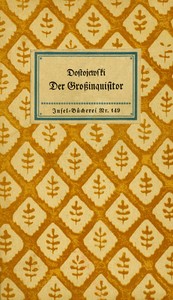
Der Großinquisitor by Fyodor Dostoyevsky
Fyodor Dostoyevsky's 'The Grand Inquisitor' is a story within a story. In the larger novel, it's a poem written and shared by one brother, Ivan, to another, Alyosha. But it stands powerfully on its own as a self-contained philosophical drama.
The Story
The scene is Seville, Spain, during the height of the Spanish Inquisition. Jesus Christ returns to Earth, walking quietly among the people, performing small acts of kindness that draw crowds. Immediately, the aged, powerful Grand Inquisitor has him arrested and thrown into a prison cell. That night, the Inquisitor visits him. What follows isn't an interrogation, but a monologue. The Inquisitor lays out a stunning accusation against Jesus. He says that by rejecting the three temptations in the desert (turning stones to bread, performing a spectacular miracle, and taking political power), Jesus chose to give humanity a burdensome gift: freedom of conscience.
The Inquisitor argues that people are weak, childish, and scared of that freedom. So, he claims, the Church—his Church—took on the 'sin' of correcting Jesus's work. They took away the freedom he offered and gave the masses what they really want: mystery, miracle, and authority. They provide bread (material security), spectacle (miracles and ritual), and a single, unifying earthly authority to worship. In his eyes, this is a more compassionate, if tyrannical, form of love. Jesus says nothing throughout the entire speech. At the end, he simply walks over and kisses the old man on his bloodless lips. The Inquisitor, shaken, lets him go into the night.
Why You Should Read It
This isn't a story with a lot of action; it's a battle of ideas that feels shockingly modern. What got under my skin was how persuasive the Inquisitor sounds. In a world full of anxiety and choice, his promise of simple answers, security, and belonging is deeply seductive. You almost find yourself nodding along, until you remember the cost: the complete surrender of your soul's freedom. The silent response from Jesus is the story's genius. It doesn't offer an easy counter-argument. Instead, that silent, loving kiss suggests that real faith and love can't be forced or managed—they have to be freely chosen, even if it's messy and dangerous.
Final Verdict
This is a perfect book for anyone who loves a story that wrestles with the biggest questions: freedom vs. security, faith vs. doubt, and what we really sacrifice for comfort. It's for thinkers, debaters, and people who don't mind a story that offers more questions than answers. If you enjoy authors like Albert Camus or George Orwell, or if you've ever argued about politics, religion, or psychology late into the night, you need to read this. It's a dense, challenging, and utterly brilliant 40-page punch to the gut.
This is a copyright-free edition. Distribute this work to help spread literacy.
James Taylor
1 year agoAs someone who reads a lot, the plot twists are genuinely surprising. Exactly what I needed.
Jessica Nguyen
8 months agoRead this on my tablet, looks great.




Sandra Gonzalez
4 months agoI stumbled upon this title and it manages to explain difficult concepts in plain English. A valuable addition to my collection.