
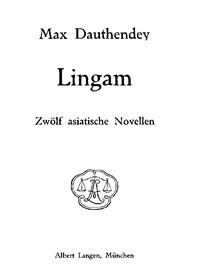
Lingam: Zwölf asiatische Novellen by Max Dauthendey
Max Dauthendey's Lingam: Zwölf asiatische Novellen is a quiet, thoughtful journey. Published in 1909, it collects twelve short stories born from the author's travels across Asia. There's no overarching plot. Instead, each story acts as a standalone snapshot, a fictionalized impression of the cultures and philosophies Dauthendey encountered.
The Story
Don't expect a traditional novel. Think of this book as a series of postcards from a deeply curious traveler. The settings shift from the serene gardens of Japan to the bustling, spiritually charged atmosphere of India. The characters are often Europeans—artists, scholars, colonists—who find themselves confronted with beliefs and customs that challenge their own. Sometimes the encounter is peaceful, a moment of shared beauty or quiet reflection. Other times, it's marked by misunderstanding, curiosity, or a sense of profound dislocation. The 'lingam' of the title, a sacred symbol in Hinduism, hints at the book's central concern: the search for spiritual and cultural essence in a world that feels both ancient and new to the Western observer.
Why You Should Read It
What struck me most was Dauthendey's voice. He's not a conqueror or a dismissive tourist; he's a participant-observer, often humbled and always trying to see. His prose has a poetic, almost painterly quality. He captures the scent of temple incense, the play of light on a rice paddy, the weight of silence in a foreign room. Reading this isn't about getting a history lesson (though you pick up plenty). It's about feeling what it was like to be a specific person at a specific moment, trying to bridge an immense gap. The stories are slow and atmospheric, perfect for when you want to be transported. They make you consider your own travels and assumptions.
Final Verdict
This book is a perfect fit for a specific kind of reader. If you love classic travel writing, early 20th-century literature, or short stories with a strong sense of place, you'll find a lot here. It's also great for anyone interested in the historical meeting of East and West, presented not as dry analysis but as lived, fictional experience. A word of caution: it's a contemplative read, not a page-turner. It asks for your patience and rewards it with unique, beautifully crafted glimpses into a vanished world. Find a quiet afternoon, pour some tea, and let Dauthendey be your guide.
This book is widely considered to be in the public domain. It serves as a testament to our shared literary heritage.
Joseph Wilson
1 year agoAfter spending a few days with this digital edition, the quality of the diagrams and illustrations (if applicable) is top-notch. A mandatory read for anyone in this industry.
Kimberly Martin
10 months agoUnlike many other resources I've purchased before, the insights into future trends are particularly thought-provoking. I'm glad I chose this over the other alternatives.
Donald Gonzalez
8 months agoThis digital copy caught my eye due to its reputation, the concise summaries at the end of each section are a lifesaver. I'll be citing this in my upcoming project.
Robert Hernandez
7 months agoHaving followed this topic for years, I can say that the author doesn't just scratch the surface but goes into meaningful detail. An excellent example of how quality digital books should be formatted.

Margaret Thomas
2 years agoLooking at the bibliography alone, the objective evaluation of the pros and cons is very refreshing. I'll be citing this in my upcoming project.