
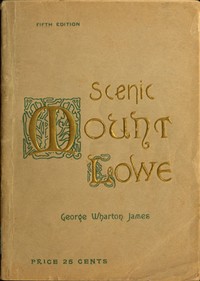
Scenic Mount Lowe and Its Wonderful Railway by George Wharton James
George Wharton James's book is less a formal history and more a loving postcard from a lost world. He acts as our guide, taking us step-by-step up the mountain, just as the original tourists would have experienced it.
The Story
The story follows the incredible journey of the Mount Lowe Railway, from its origin in the mind of Civil War balloonist Thaddeus Lowe to its final days. James walks us through the whole experience. We start at the foot of the mountain in Altadena, board the electric trolley, and begin the climb. He describes the terrifyingly steep grades, the stunning bridges over deep canyons, and the famous 'Circular Bridge' where the train did a full loop. We get off at the mountaintop resorts—the Alpine Tavern and Echo Mountain House—and learn what visitors did there, from dancing to gazing at the stars. But the narrative also doesn't shy away from the struggle. We see the constant battle against wildfires, the financial troubles, and how the rise of the automobile slowly made this wonder obsolete. The story ends with the railway's quiet fading, leaving only traces in the forest.
Why You Should Read It
What makes this book special is James's genuine awe. He’s not just listing facts; he’s trying to make you feel the cool mountain air and the thrill of the ride. His descriptions are vivid and personal. You get a real sense of the people—the optimistic promoters, the brave engineers, and the everyday tourists seeking adventure. For me, the most powerful theme is the tension between human creation and nature. Here was this massive, noisy, brilliant machine carved into a silent wilderness. It’s a story about what we build, and what eventually reclaims it. Reading it feels like uncovering a secret. You’ll look at the San Gabriel Mountains today and imagine the ghost of a train whistle echoing through the pines.
Final Verdict
This is a perfect book for anyone with a curiosity about hidden history and American ingenuity. It’s a must-read for Southern California locals who hike those trails and have no idea what once existed there. It’s also great for fans of engineering, vintage travel writing, or anyone who just loves a good 'they actually did that?' story. It’s a quick, engaging, and surprisingly moving portrait of a dream that left its mark on a mountain. Just be warned: after reading it, you might feel a powerful urge to go looking for the old railway ties still hiding in the brush.
No rights are reserved for this publication. Thank you for supporting open literature.
James Martin
1 year agoAfter a thorough walkthrough of the table of contents, the way the author breaks down the core concepts is remarkably clear. I appreciate the effort that went into this curation.
Kimberly Davis
4 months agoLooking at the bibliography alone, the author clearly has a deep mastery of the subject matter. I'm genuinely impressed by the quality of this digital edition.
Donald Brown
1 year agoMy first impression was quite positive because the evidence-based approach makes it a very credible source of information. Simple, effective, and authoritative – what else could you ask for?
Sarah Brown
4 months agoI've gone through the entire material twice now, and the data points used to support the main thesis are quite robust. It’s hard to find this much value in a single source these days.






Linda Jackson
8 months agoExtremely helpful for my current research project.