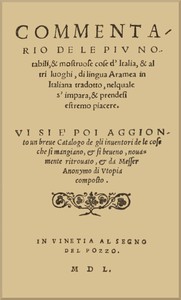
Commentario de le piu notabili, & mostruose cose d'Italia, & di altri luoghi di…
Let’s get one thing straight: this is not a standard travel guide. Published in the mid-1500s, Ortensio Landi’s Commentario is a deliberate tour of Italy’s strangest attractions. Forget the perfect beaches or the best pasta (though I’m sure he enjoyed some). Landi was hunting for the peculiar, the unexplained, and the downright monstrous.
The Story
There’s no traditional plot with a hero and a villain. Instead, the ‘story’ is Landi’s journey of curiosity. He structures his book as a series of observations and reports from different regions. One entry might describe a spring whose waters are said to petrify objects. The next could detail a local legend about a dragon or a strange, misshapen statue worshipped in a village. He catalogs bizarre natural phenomena, architectural wonders that defy logic, and creatures from folklore. It’s a snapshot of a world where the line between fact, legend, and superstition was beautifully blurry.
Why You Should Read It
This book is a joy because of Landi’s voice. You can feel his fascination. He’s not always saying, "This is absolutely true." Sometimes he’s more like, "Can you believe people say this happens here? Let’s talk about it." It gives you a direct line to what captivated and scared people 500 years ago. The themes are timeless: human curiosity, our love for a good story, and the desire to explain the unexplainable. Reading it feels like uncovering a secret cabinet of curiosities. You’re not just learning about odd rocks or old tales; you’re getting a sense of how people saw their world before modern science explained everything away.
Final Verdict
Perfect for history buffs who are tired of dry dates and battles, or for anyone who loves "Ripley’s Believe It or Not!" style oddities but wants it with a heavy dose of authentic Renaissance flair. It’s also great for travel enthusiasts—it’ll make you look at Italy in a whole new light. Fair warning: it’s a historical text, so the language (even in translation) can be dense in spots. But if you approach it as a collection of weird and wonderful snippets rather than a novel, it’s endlessly entertaining. Think of it as the original weird internet, compiled in a book by a very passionate, slightly eccentric guide.
This historical work is free of copyright protections. You can copy, modify, and distribute it freely.