
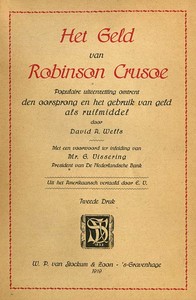
Het Geld van Robinson Crusoe by David Ames Wells
Let's set the scene: Robinson Crusoe is alone on his island. He has to find food, build shelter, and make tools. Every choice he makes is about using his time and energy wisely. Het Geld van Robinson Crusoe (The Money of Robinson Crusoe) isn't a retelling of the adventure. Instead, author David Ames Wells uses each step of Crusoe's survival as a clear example of basic economic principles.
The Story
There isn't a traditional plot with new characters. The 'story' is Wells walking us through Crusoe's years on the island and highlighting the economic lessons. He shows how Crusoe's labor is his first capital. Building a canoe isn't just a survival task; it's an investment of time that pays off in future fishing efficiency. The book gets really interesting when Friday arrives. Suddenly, Crusoe isn't just working for himself. They have to figure out a system of exchange and cooperation. Then, Wells introduces the twist: a chest of gold coins from a wrecked ship. On a deserted island, what good is gold? It's a powerful moment that makes you question what we think of as 'real' wealth.
Why You Should Read It
I loved this because it made me see a classic story in a completely new light. Economics can feel abstract and full of jargon, but here, it's grounded in the most basic human experience: creating a life from nothing. Wells writes with a clear, almost conversational style for his time. You feel like you're solving a puzzle alongside him. The book brilliantly shows that economics isn't just about stock markets and banks; it starts with the choices we make every day about what to build, save, or trade. It makes you think about the value of your own work in a fresh way.
Final Verdict
This is a hidden gem for curious readers. It's perfect if you enjoy history, classic literature, or want a painless introduction to economic thinking. It's also great for book clubs—imagine the discussion about the gold coins! Because it uses a familiar story as its foundation, it's incredibly accessible. Don't expect a thrilling narrative; instead, expect a short, insightful, and surprisingly engaging lecture from a 19th-century thinker that still feels relevant today. If the idea of 'Robinson Crusoe as an economics textbook' makes you smile, you'll probably enjoy this.
Legal analysis indicates this work is in the public domain. Knowledge should be free and accessible.
Mark Taylor
9 months agoHigh quality edition, very readable.
Kenneth Walker
6 months agoI stumbled upon this title and the emotional weight of the story is balanced perfectly. This story will stay with me.
Anthony Lopez
1 year agoAmazing book.
Michelle Allen
1 year agoAfter hearing about this author multiple times, the content flows smoothly from one chapter to the next. I will read more from this author.

Margaret Wright
1 year agoI started reading out of curiosity and the emotional weight of the story is balanced perfectly. Thanks for sharing this review.