
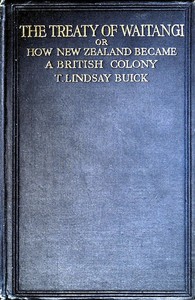
The Treaty of Waitangi; or, how New Zealand became a British Colony by Buick
So, what's this book actually about? Thomas Buick, writing in the early 1900s, set out to explain how New Zealand became part of the British Empire. He doesn't just give you the date and the names. He walks you through the whole messy lead-up.
The Story
Buick starts with the wild, unregulated frontier that was New Zealand before 1840. British settlers were arriving, land deals were chaotic, and the British government felt it had to step in. Enter Captain William Hobson, sent to get Māori chiefs to sign a treaty. The book shows how the treaty was rushed. The English version promised Māori "full, exclusive and undisturbed possession" of their lands, while the Māori translation used the word "kawanatanga" (governance) for sovereignty, a concept that didn't have a direct equivalent. Buick details the debates at Waitangi, the travels to get more signatures, and the immediate aftermath. The "story" is really about how this agreement, meant to bring order, instead planted the seeds for misunderstanding that would grow for generations.
Why You Should Read It
Here's the thing: Buick writes with the passion of someone who truly cares about this history. He's not a detached academic. You can feel his frustration with the clumsy process and his admiration for figures like the missionary Henry Williams, who did the crucial translation. Reading it today, with all we know about the later land wars and grievances, it's fascinating—and sometimes heartbreaking—to see the origins so clearly. Buick helps you understand that the Treaty debates aren't about ancient history; they're about a founding document that was confusing from day one. It makes you think about how nations are built, not on perfect agreements, but on flawed human attempts at understanding.
Final Verdict
This is a classic for a reason. It's perfect for anyone curious about New Zealand's real origin story, not just the simplified version. If you're a local who wants to understand the roots of today's conversations, or a visitor trying to grasp the country's complex heart, this is a fantastic starting point. Just remember, Buick was writing in a different time, so his perspective is very much of its era. Read it not as the final word, but as the compelling first major attempt to tell this crucial story. It's a foundational text that still sparks conversation.
This digital edition is based on a public domain text. You do not need permission to reproduce this work.
Linda Thomas
2 months agoIf you're tired of surface-level information, the argument presented in the middle section is particularly compelling. Thanks for making such a high-quality version available.
George Rodriguez
10 months agoI particularly value the technical accuracy maintained throughout.
James Thomas
10 months agoI've been looking for a reliable source on this topic, and the level of detail in the second half of the book is truly impressive. I am looking forward to the author's next publication.
Linda Moore
5 months agoI started reading this with a critical mind, the logic behind each conclusion is easy to follow and verify. I feel much more confident in my knowledge after finishing this.

Richard Thomas
2 years agoInitially, I was looking for a specific answer, but the argument presented in the middle section is particularly compelling. An excellent example of how quality digital books should be formatted.