About 476 minutes
Rilla of Ingleside — Key Ideas to Explore
Young Readers Enchanted Adventures
109,344 recorded words. 954 minutes difference from this book's estimate.
View Gutenberg source #3796
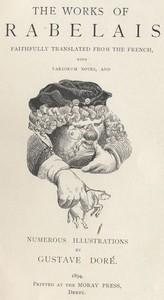
Before opening Gargantua and Pantagruel — Story, Setting & Ideas, the edition data offers a quick orientation: 328,773 words, 23 hr 50 min estimated reading time, and 41 detected text sections.
The text analysis averages about 27.9 words per sentence, while the detected sections provide another way to judge how the source is divided.
Project Gutenberg metadata also associates the work with “Giants -- Fiction,” connecting these edition facts with the source record’s subject description.
Explore this collection
These alternatives are selected using recorded categories and estimated reading time.
About 476 minutes
Young Readers Enchanted Adventures
109,344 recorded words. 954 minutes difference from this book's estimate.
View Gutenberg source #3796About 469 minutes
Young Readers Enchanted Adventures
107,774 recorded words. 961 minutes difference from this book's estimate.
View Gutenberg source #10449About 390 minutes
Young Readers Enchanted Adventures
89,582 recorded words. 1040 minutes difference from this book's estimate.
View Gutenberg source #12963Search stored excerpts and compare books → Choose by your preferences →
Choices use stored catalog measurements. Estimates vary with reading speed. A shared category is a catalog label, not a claim that two books have the same argument or literary quality.
Search reads excerpt text stored with this catalog and links to its associated Gutenberg record. The connection is stored in the site database; this tool does not recheck that every excerpt is word-for-word identical to that external record. Excerpt search does not cover every chapter and does not verify historical publication dates.
Catalog snapshot checked: 2026-09-26. Coverage: 99 public books, 99 available source excerpts.
Calculated from edition completeness, EPUB availability, text structure and catalogue metadata. Not a user rating.
Total of 100 points, scaled to a 2.5-5.0 range. Editions with an empty description or a missing EPUB file are not scored.
Public-domain source text
The source text is kept in the dedicated reader, separate from this catalogue record and its commentary.
The excerpt from Book III, in which Panurge consults the astrologer Herr Trippa, exemplifies Rabelais’s characteristic juxtaposition of erudite systems with coarse physicality. Trippa’s elaborate geomancy, horoscopy, and metoposcopy are undercut by the revelation that his wife is routinely unfaithful while he prates to the king. The scene moves briskly from Trippa’s confident predictions to Panurge’s angry retort, a pattern of deflation that recurs throughout the work.
The consultation with Herr Trippa follows a recognizable pattern: a character seeks advice, receives an elaborate pseudo-scientific reading, and then reacts with indignation or mockery. This structure appears repeatedly in the later books, where Panurge consults a series of authorities—theologians, lawyers, philosophers—each time receiving a verdict that is both certain and contradictory. The repetition creates a rhythm of expectation and comic reversal. In this instance, Trippa’s detailed analysis of Panurge’s hand and horoscope leads to a blunt prediction of cuckoldry, which Panurge answers with a curse and a threat. The scene’s symmetry—question, exposition, rebuttal—mirrors the larger pattern of the work, where learned discourse is systematically destabilized by practical reality.
Rabelais employs a dense network of images that link bodily experience to cosmic signs. In the excerpt, Trippa reads Panurge’s right hand, noting a “rugged draught” under the mount of Jove as proof of future cuckoldry. The hand becomes a microcosm of fate, its lines interpreted with the same gravity as planetary aspects. Horned signs—Aries, Taurus, Capricorn—are cited as threatening influences, reinforcing the motif of cuckoldry as a horned condition. These images recur across the books: giants’ bodies, monastic robes, and even the shape of words are subjected to similar symbolic readings. The effect is to create a world where every surface is legible, yet no interpretation is stable.
The excerpt moves from the court of the “great king” to Trippa’s lodging, a shift that underscores the contrast between public authority and private vulnerability. At court, Trippa speaks of “celestial, sublime, and transcendent things”; in his own home, he is oblivious to his wife’s infidelity. This spatial movement—from elevated to domestic, from formal to intimate—is a recurring technique in Rabelais. The narrative often descends from philosophical debate to bodily necessity, from the library to the dining hall, or from the battlefield to the bedroom. These transitions are abrupt, emphasizing the instability of any single setting or register of discourse.
Trippa’s speech is saturated with technical terms: metoposcopy, geomancy, horoscope, triplicities, tetragonal aspect. This jargon is presented with deadpan seriousness, only to be shattered by Panurge’s colloquial outburst: “A plague rot thee, thou old fool and doting sot.” The contrast between the two registers is central to Rabelais’s comic method. The work frequently alternates between Latinate erudition and earthy French idioms, between formal argument and physical insult. This mixing of voices prevents any single perspective from dominating, and it invites the reader to question the authority of learned systems. The excerpt demonstrates how quickly high discourse can collapse into personal abuse.
Readers approaching this work should attend to the way Rabelais builds scenes around the failure of expertise. The consultation with Herr Trippa is not an isolated joke but part of a sustained critique of certainty. The book rewards those who follow the movement between high and low, between abstract system and concrete detail, without expecting a final resolution.
I kept thinking about that old editorial note on Gargantua and Pantagruel, how the lofty arguments always collapse into bodily jokes. There's a similar quiet ache in Dick Prescott's Second Year at West Point Or, Finding the Glory of the Soldier's Life — A Closer Reading—the way duty and awkwardness sit side by side, never quite resolving. It stayed with me like a half-remembered conversation.
Your answers remain private and are stored only in this browser.