About 81 minutes
The Adventures of Old Mr. Toad — Themes and Context
Young Readers Enchanted Adventures
18,595 recorded words. 6 minutes difference from this book's estimate.
View Gutenberg source #12630
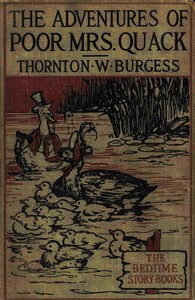
The Adventures of Poor Mrs. Quack — Reading Companion can be approached with a clearer sense of reading commitment from its source measurements: 19,844 words, 1 hr 27 min estimated reading time, and 23 detected text sections.
The text analysis averages about 15.7 words per sentence, while the detected sections provide another way to judge how the source is divided.
Project Gutenberg metadata also associates the work with “Animals -- Juvenile fiction,” connecting these edition facts with the source record’s subject description.
Explore this collection
These alternatives are selected using recorded categories and estimated reading time.
About 81 minutes
Young Readers Enchanted Adventures
18,595 recorded words. 6 minutes difference from this book's estimate.
View Gutenberg source #12630About 74 minutes
Young Readers Enchanted Adventures
16,990 recorded words. 13 minutes difference from this book's estimate.
View Gutenberg source #1578About 63 minutes
Young Readers Enchanted Adventures
14,363 recorded words. 24 minutes difference from this book's estimate.
View Gutenberg source #11121Search stored excerpts and compare books → Choose by your preferences →
Choices use stored catalog measurements. Estimates vary with reading speed. A shared category is a catalog label, not a claim that two books have the same argument or literary quality.
Search reads excerpt text stored with this catalog and links to its associated Gutenberg record. The connection is stored in the site database; this tool does not recheck that every excerpt is word-for-word identical to that external record. Excerpt search does not cover every chapter and does not verify historical publication dates.
Catalog snapshot checked: 2026-09-26. Coverage: 99 public books, 99 available source excerpts.
Calculated from edition completeness, EPUB availability, text structure and catalogue metadata. Not a user rating.
Total of 100 points, scaled to a 2.5-5.0 range. Editions with an empty description or a missing EPUB file are not scored.
Public-domain source text
The source text is kept in the dedicated reader, separate from this catalogue record and its commentary.
From the opening lines, Burgess establishes a narrative voice that blends natural history with moral reflection. When Peter Rabbit first spies Mrs. Quack, the description immediately distinguishes her from domestic ducks: she is "smaller, brown, very trim, and looked anything but stupid." This careful contrast sets the tone for a story that respects its animal characters as individuals with distinct experiences. The dialogue that follows reveals Burgess's technique of embedding exposition within character interaction. Mrs. Quack does not simply narrate her journey; she conveys it through emotionally charged speech, punctuated by pauses and sobs. Peter's responses—nodding, offering comfort, and later sitting in "a brown study"—show how Burgess uses physical reactions to deepen characterization without lengthy internal monologue.
Burgess's word choices consistently reinforce the threat of hunting. Mrs. Quack describes the gunfire as a "bang, bang of a terrible gun," and the repetition of "terrible" (appearing in chapter titles and dialogue) becomes a refrain that underscores the danger. The phrase "down fell Mr. Quack" is stark and immediate, contrasting with the earlier description of "swift, strong wings." This juxtaposition of vitality and sudden collapse is a recurring pattern: the narrative builds a sense of normalcy only to shatter it with violence. Even Peter's internal response—"Peter's own eyes were full of tears"—uses simple, concrete language to convey empathy without sentimentality. The diction remains accessible yet precise, avoiding euphemism for the hunt's consequences.
Burgess uses dialogue to reveal personality and emotional state. Mrs. Quack's speech is marked by hesitations and emotional breaks: "I am afraid he was killed, and if he was, I wish I had been killed myself." The raw, unguarded quality of her words contrasts with Peter's more measured replies. When Peter says, "Perhaps Mr. Quack wasn't killed and is hiding somewhere," his optimism is undercut by Mrs. Quack's practical fear—she cannot approach the shore to search. This exchange highlights a central tension: the desire to help versus the limitations imposed by danger. Peter's later remark to Jerry Muskrat—"It's lucky for me that Mrs. Peter wasn't here to hear her say that"—adds a layer of domestic humor, showing how Burgess uses dialogue to shift tone and remind readers of the broader community of characters.
The narrative is structured around a series of arrivals and departures. Mrs. Quack appears at the Smiling Pool, tells her story, and then leaves to search for her mate, promising to return. This cyclical pattern—arrival, revelation, departure—creates a rhythm of hope and uncertainty. The chapter titles themselves function as a suspense mechanism: "Mrs. Quack Tells About Her Home," "Mrs. Quack Continues Her Story," "Peter Learns More of Mrs. Quack's Troubles." Each chapter advances the backstory incrementally, parceling out information about the Quacks' journey and the shooting. Burgess also uses the physical setting—the Smiling Pool as a temporary sanctuary—to frame the action. The pool is described as safe, but the threat of predators like Reddy Fox lurks at the edges, reminding readers that safety is provisional.
Burgess plants small, telling details that accumulate meaning. Mrs. Quack's repeated references to the "Big River" anchor the story in a specific geography, while the phrase "terrible gun" appears in both dialogue and chapter headings, linking the abstract threat to a concrete object. Peter's habit of sitting "in a brown study" is mentioned twice, signaling his role as a thoughtful observer. The illustrations by Harrison Cady, though not reproduced here, are referenced in the list of plates, suggesting that visual cues—such as the image of Mrs. Quack circling high over the Smiling Pool—complement the text's emphasis on vigilance. These recurring elements create a cohesive world where every detail, from the trimness of Mrs. Quack's feathers to the sound of gunfire, contributes to the story's emotional and thematic weight.
Readers attentive to Burgess's craft will notice how he balances the gravity of Mrs. Quack's situation with the gentle humor of Peter's domestic life. The story does not resolve the threat of hunting; instead, it leaves Mrs. Quack in a state of anxious waiting. This open-endedness is a deliberate choice, inviting readers to consider the ongoing vulnerability of migratory birds. Pay particular attention to how Burgess uses the natural setting—the Smiling Pool, the Big River, the rushes—as both a refuge and a reminder of danger.
The rain drummed on the window while I followed Mrs. Quack’s trembling search for safety, and I felt the odd weight of a creature whose only hope is stillness. That quiet fear nudged me later toward something stranger, a bawdy giant’s tale. Gargantua and Pantagruel, Illustrated, Book 3 — Themes and Context holds appetite where Burgess held caution, but both know how loudly bodies announce their presence.
Build a private reading journal entry for this title.