About 87 minutes
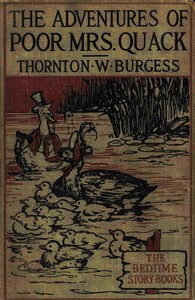
The Adventures of Poor Mrs. Quack — Reading Companion
Young Readers Enchanted Adventures
19,844 recorded words. 6 minutes difference from this book's estimate.
View Gutenberg source #5846
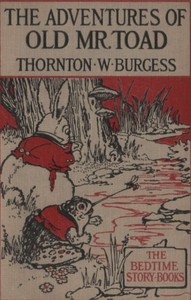
The catalog record for The Adventures of Old Mr. Toad — Themes and Context provides practical reading context through 18,595 words, 1 hr 21 min estimated reading time, and 3 detected text sections.
The text analysis averages about 13.3 words per sentence, while the detected sections provide another way to judge how the source is divided.
Project Gutenberg metadata also associates the work with “Animals -- Juvenile fiction,” connecting these edition facts with the source record’s subject description.
Explore this collection
These alternatives are selected using recorded categories and estimated reading time.
About 87 minutes
Young Readers Enchanted Adventures
19,844 recorded words. 6 minutes difference from this book's estimate.
View Gutenberg source #5846About 74 minutes
Young Readers Enchanted Adventures
16,990 recorded words. 7 minutes difference from this book's estimate.
View Gutenberg source #1578About 63 minutes
Young Readers Enchanted Adventures
14,363 recorded words. 18 minutes difference from this book's estimate.
View Gutenberg source #11121Search stored excerpts and compare books → Choose by your preferences →
Choices use stored catalog measurements. Estimates vary with reading speed. A shared category is a catalog label, not a claim that two books have the same argument or literary quality.
Search reads excerpt text stored with this catalog and links to its associated Gutenberg record. The connection is stored in the site database; this tool does not recheck that every excerpt is word-for-word identical to that external record. Excerpt search does not cover every chapter and does not verify historical publication dates.
Catalog snapshot checked: 2026-09-26. Coverage: 99 public books, 99 available source excerpts.
Calculated from edition completeness, EPUB availability, text structure and catalogue metadata. Not a user rating.
Total of 100 points, scaled to a 2.5-5.0 range. Editions with an empty description or a missing EPUB file are not scored.
Public-domain source text
The source text is kept in the dedicated reader, separate from this catalogue record and its commentary.
The Adventures of Old Mr. Toad opens with a characteristic Burgess scene: Old Mother West Wind releases the Merry Little Breezes, and Jimmy Skunk ambles down the Lone Little Path. The narrative voice is unhurried, matching Jimmy's lazy gait, but soon introduces a puzzle—Old Mr. Toad is hurrying, which is “very unusual indeed.” The prose slows to note each hop and pause, then quickens with Mr. Toad's breathless arrival. This contrast in pace, from Jimmy's leisurely stroll to Mr. Toad's determined haste, sets up a story built on small mysteries and patient observation.
The book's opening establishes a deliberate rhythm. Jimmy Skunk “ambles” and “never hurries,” and the narrator takes time to describe Old Mother West Wind's sigh and her work turning windmills. Then Mr. Toad appears, “puffing and blowing,” hopping “in the most determined way.” The shift is abrupt: the text moves from lazy description to short, urgent sentences. This change in pace mirrors the central tension—Mr. Toad's unusual hurry hints at something important, but the story refuses to rush. Instead, it lets readers wonder alongside Jimmy, who is “puzzled.” The pace slows again as Jimmy consults friends, building anticipation without revealing the cause.
Burgess gives each animal a distinct speech pattern. Old Mr. Toad is blunt and grumpy, using short retorts: “Hump!” and “Certainly not!” Peter Rabbit, by contrast, speaks in longer, more curious sentences, often admitting his mistakes (“That's so,” “I didn't think of that”). The dialogue drives the narrative forward, with Peter's questions prompting Mr. Toad's explanations. The pace quickens during their exchanges, especially when Mr. Toad challenges Peter to turn his back for five minutes. The countdown creates suspense, and the payoff—Mr. Toad's disappearance—is delivered in a single, flat sentence: “Old Mr. Toad was nowhere to be seen.” The abruptness contrasts with the earlier leisurely description, emphasizing the trick.
In chapter XV, the narrative pace mirrors Peter's confusion. After Mr. Toad vanishes, Peter “looked hastily this way and that way,” and the sentences become shorter, mimicking his frantic search. The narrator steps back to comment: “Peter should have known better.” This shift to a slightly omniscient tone slows the action, giving readers a moment to reflect on Peter's gullibility. The scene then cuts to Mr. Toad's perspective, revealing he “was getting even with Peter for laughing at him.” This quick change in viewpoint—from Peter's bewilderment to Mr. Toad's satisfaction—alters the pace again, adding a layer of dramatic irony. The reader now knows what Peter does not, and the story can afford to linger on Peter's fruitless search.
Burgess's narrative voice remains consistently warm and slightly moralizing, but it never lectures. Instead, it lets the animals' actions and dialogue teach lessons about patience, humility, and the wonders of nature. Readers who pay attention to the shifts in pace—from lazy ambles to sudden rushes, from long descriptions to terse revelations—will find a story that rewards careful reading. The book's structure, built on small puzzles and their gradual solutions, mirrors the slow, observant approach it encourages in its audience.
Reading about Old Mr. Toad’s hurried spring rush, I found myself thinking of another kind of restless journey—the wide-open trails in Cowboy Dave; Or, The Round-up at Rolling River — Reading Companion. Both feel like quiet afternoons spent watching a character move through their own world, unhurried and purposeful, each step a small adventure.
Capture what you thought, learned, and would like to remember.