About 129 minutes
Wee Johnnie Paterson, & other humorous sketches — Story, Setting & Ideas
Utopias Future Societies Other Worlds
29,460 recorded words. 13 minutes difference from this book's estimate.
View Gutenberg source #76637
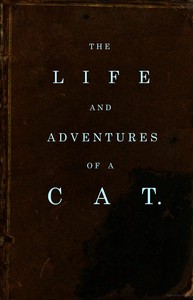
The life and adventures of a cat — Themes and Context can be approached with a clearer sense of reading commitment from its source measurements: 26,501 words, 1 hr 56 min estimated reading time, and 22 detected text sections.
The text analysis averages about 44.5 words per sentence, while the detected sections provide another way to judge how the source is divided.
Project Gutenberg metadata also associates the work with “Cats -- Fiction,” connecting these edition facts with the source record’s subject description.
Explore this collection
These alternatives are selected using recorded categories and estimated reading time.
About 129 minutes
Utopias Future Societies Other Worlds
29,460 recorded words. 13 minutes difference from this book's estimate.
View Gutenberg source #76637About 95 minutes
Utopias Future Societies Other Worlds
21,787 recorded words. 21 minutes difference from this book's estimate.
View Gutenberg source #1676About 58 minutes
Utopias Future Societies Other Worlds
13,197 recorded words. 58 minutes difference from this book's estimate.
View Gutenberg source #76083Search stored excerpts and compare books → Choose by your preferences →
Choices use stored catalog measurements. Estimates vary with reading speed. A shared category is a catalog label, not a claim that two books have the same argument or literary quality.
Search reads excerpt text stored with this catalog and links to its associated Gutenberg record. The connection is stored in the site database; this tool does not recheck that every excerpt is word-for-word identical to that external record. Excerpt search does not cover every chapter and does not verify historical publication dates.
Catalog snapshot checked: 2026-09-26. Coverage: 99 public books, 99 available source excerpts.
Calculated from edition completeness, EPUB availability, text structure and catalogue metadata. Not a user rating.
Total of 100 points, scaled to a 2.5-5.0 range. Editions with an empty description or a missing EPUB file are not scored.
Public-domain source text
The source text is kept in the dedicated reader, separate from this catalogue record and its commentary.
The narrator opens with a mock-philosophical disquisition on the sagacity of cats, ranking them above owls and asses in a parodic tournament of wisdom. The prose is deliberately inflated, invoking Pliny and the ancients, yet undercut by comic asides about old women who call cats witches and almanac-makers. This high-flown tone immediately clashes with the grim reality that follows: Tom, the feline protagonist, is born into a world where his siblings are killed, and he himself is delivered into the hands of a savage dancing-master. The contrast between the narrator's learned pretensions and the brute facts of Tom's life sets up a central tension that runs through the entire work.
The first chapter establishes a pattern of ironic disjunction. The narrator solemnly argues for the cat's superiority over other animals, citing its 'uncommon prudery' and 'sedateness,' yet the evidence offered is folk superstition—washing its face as a weather sign. This mock-erudition is immediately followed by a stark account of Tom's capture: 'better had it been for thee, ere thy eyes were opened, to have shared the fate of thy brethren and sisters.' The philosophical frame cannot contain the pathos of the kitten's plight. The narrator's voice oscillates between detached wit and genuine compassion, as when he calls Tom's fate 'so tragic a nature, as may extort tears from many of our compassionate readers.' This instability—between satire and sympathy—is the work's most distinctive feature.
Tom's training under a German posture-master is described in elaborate, mock-heroic detail. He learns to leap through a hoop, beg, and climb a 'perpendicular ladder of ropes,' all while the master boasts in broken English: 'me hav one kot, dat vil bring me more monis... dan all my monkies togeder.' The whip and bell are set aside, yet Tom is tied with whip-cord. The narrator draws a biblical parallel—Dalilah binding Sampson—but Tom gnaws through his bonds, only to find the door shut. This episode is rich in structural irony: the master's inflated expectations are undercut by Tom's animal instincts, and the reader is made to see the training as both absurd and cruel. The passage also introduces a key motif: the failure of language. Tom's fellow prisoners, a baboon and other beasts, speak 'an unknown language,' cutting off the conversation he desires.
When Tom approaches the old baboon with a 'loud mew,' he receives a 'loud chatter' in return. Extending his paw in friendship, he is bitten 'almost to the bone.' The narrator comments that Tom judged his fellow-prisoner's heart by his own integrity—a naive assumption that proves disastrous. This moment crystallizes the work's concern with the limits of interspecies understanding. The menagerie is a microcosm of a world where creatures are thrown together without common ground, subject to the same 'intolerable cruelty' of confinement and starvation. The narrator's tone here is more somber than satirical, suggesting that the real subject is not feline cleverness but the universal experience of suffering under arbitrary power. The episode foreshadows further adventures in which Tom must navigate a world that is indifferent or hostile to his nature.
Readers should attend to the narrator's shifting voice—now mock-heroic, now tender—as it modulates between philosophical digression and stark narrative. The work's episodic structure and incomplete surviving text mean that many questions about Tom's ultimate fate remain open. Approach it as a satire that uses a cat's-eye view to expose human folly and cruelty, but be prepared for moments of genuine pathos that complicate the comic frame.
Rain fell in sheets against my window while Tom the Cat endured his eighteenth-century miseries, and I found myself thinking how oddly his suffering mirrored our own blindness to what we truly need. That afternoon, quite without plan, I drifted from his worldly trials to Plato's quieter probing of self-knowledge in Alcibiades I — Key Ideas to Explore, and the rain seemed to soften around that old question of caring for the soul.
Use these questions to collect your thoughts before moving on.