About 238 minutes
The Rover Boys In The Mountains; Or, A Hunt for Fun and Fortune — Reading Notes
Young Readers Enchanted Adventures
54,733 recorded words. 2 minutes difference from this book's estimate.
View Gutenberg source #13455
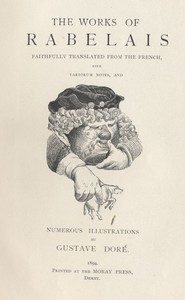
The source record for Gargantua and Pantagruel, Illustrated, Book 2 — Inside the Classic measures this digital text at 54,211 words, 3 hr 56 min estimated reading time, and 7 detected text sections.
The text analysis averages about 29.8 words per sentence, while the detected sections provide another way to judge how the source is divided.
Project Gutenberg metadata also associates the work with “Giants -- Fiction,” connecting these edition facts with the source record’s subject description.
Explore this collection
These alternatives are selected using recorded categories and estimated reading time.
About 238 minutes
Young Readers Enchanted Adventures
54,733 recorded words. 2 minutes difference from this book's estimate.
View Gutenberg source #13455About 243 minutes
Young Readers Enchanted Adventures
55,800 recorded words. 7 minutes difference from this book's estimate.
View Gutenberg source #7963About 223 minutes
Young Readers Enchanted Adventures
51,222 recorded words. 13 minutes difference from this book's estimate.
View Gutenberg source #12690Search stored excerpts and compare books → Choose by your preferences →
Choices use stored catalog measurements. Estimates vary with reading speed. A shared category is a catalog label, not a claim that two books have the same argument or literary quality.
Search reads excerpt text stored with this catalog and links to its associated Gutenberg record. The connection is stored in the site database; this tool does not recheck that every excerpt is word-for-word identical to that external record. Excerpt search does not cover every chapter and does not verify historical publication dates.
Catalog snapshot checked: 2026-09-26. Coverage: 99 public books, 99 available source excerpts.
Calculated from edition completeness, EPUB availability, text structure and catalogue metadata. Not a user rating.
Total of 100 points, scaled to a 2.5-5.0 range. Editions with an empty description or a missing EPUB file are not scored.
Public-domain source text
The source text is kept in the dedicated reader, separate from this catalogue record and its commentary.
François Rabelais's Gargantua and Pantagruel, Book II opens with a mock-heroic genealogy that parodies chronicle traditions, tracing Pantagruel's lineage through giants and legendary figures. The narrative voice shifts between scholarly gravity and bawdy irreverence, a duality that defines the work's comic strategy. The translator's preface notes that Urquhart's 1653 rendering preserves the original's verbal play, as seen in the Limousin scholar's affected speech, which Rabelais lampoons by having Pantagruel physically throttle the man for his pretentious Gallicized Latin. This episode exemplifies how Rabelais uses dialogue to satirize pedantry, a recurring target throughout the book.
The opening chapters employ a deliberately inflated style, mimicking classical epic genealogies while undercutting them with absurd details. Pantagruel's birth is described with pseudo-scientific precision, yet the infant emerges so enormous that he suffocates his mother—a grotesque twist on heroic nativity. Rabelais's diction oscillates between Latinate solemnity and colloquial bluntness, as when Gargantua's grief over his wife's death is rendered in a comically pragmatic speech: 'We must not grieve for the dead, but for the living.' The catalog of giants in Pantagruel's ancestry includes figures like 'Gabbara' and 'Hurtaly,' names that sound authoritative but are likely invented or distorted from folklore. This technique mocks the reader's expectation of historical veracity, establishing a tone where erudition and nonsense coexist.
Chapter 2.VI presents a sustained parody of affected speech. A scholar from Limoges addresses Pantagruel in a jargon that mixes French with Latinized neologisms: 'We transfretate the Sequane at the dilucul and crepuscul.' Pantagruel's response is to seize the man by the throat, demanding plain language. The scholar's subsequent confession reveals that his mother tongue is 'Limousin,' and his pretentiousness is a social affectation. Rabelais here critiques the fashion for Latinate French among the learned, using dialogue as a weapon. The episode also showcases the translator's skill: Urquhart renders the scholar's gibberish as 'we transverberate the Sequane with our oars,' preserving the comic effect. This scene is a microcosm of the book's broader satire of intellectual vanity.
Chapter 2.XVI offers a detailed inventory of Panurge's pockets, each containing implements for pranks: 'a little knife as sharp as a glover's needle' for cutting purses, 'clotburrs' to attach to clothing, and 'burning glasses' to discomfit churchgoers. The description is exhaustive, listing over twenty-six pockets with specific contents. Rabelais uses this catalog to characterize Panurge as a figure of chaotic ingenuity, his tricks ranging from petty theft to elaborate humiliations. The prose rhythm is additive, piling detail upon detail, mirroring the character's relentless mischief. Notably, the narrator maintains a deadpan tone, reporting these actions without moral judgment, which amplifies the comedy. This technique of descriptive inventory recurs throughout the book, turning character traits into tangible objects.
In the same chapter, Panurge sews a friar's vestments to his undergarments, causing him to expose himself when disrobing. The scene is narrated with precise physical detail: 'he plucked off withal both his frock and shirt, which were well sewed together.' The dialogue that follows—a lord exclaiming, 'Will this fair father make us here an offering of his tail to kiss it?'—combines verbal wit with visual slapstick. Rabelais uses this episode to satirize clerical hypocrisy and public modesty. The narrator notes that afterward, friars were required to disrobe in private, a mock-legal conclusion that parodies institutional reform. The interplay between action and commentary exemplifies Rabelais's method: the physical comedy is never gratuitous but always tied to a critique of social conventions.
Readers approaching Gargantua and Pantagruel, Book II should attend to the interplay between the translators' choices and Rabelais's original wordplay. Urquhart's English often amplifies the text's exuberance, while Motteux's later revisions smooth some edges. The excerpts reveal a work that demands flexibility: one moment a learned allusion, the next a scatological joke. The book rewards those who read with an ear for parody and an eye for the absurd logic of its invented world.
Leafing back through Rabelais’ carnival of words, where learning and lavatory humor share one muddy banquet, I found myself oddly soothed by the grammar of laughter. It made me pause and think of gentler chaos, the quiet war in the Ingleside kitchen, where tender hearts also make their clumsy armor. Both books understand the messy business of becoming oneself. Rilla of Ingleside — Key Ideas to Explore came to mind, a different kind of strength, but the same stubborn pulse beneath the mud and mail.
Build a private reading journal entry for this title.