About 390 minutes
Melbourne House, Volume 1 — Themes and Context
Young Readers Enchanted Adventures
89,582 recorded words. 3 minutes difference from this book's estimate.
View Gutenberg source #12963
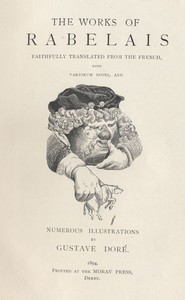
The source record for Gargantua and Pantagruel, Illustrated, Book 3 — Themes and Context measures this digital text at 88,787 words, 6 hr 27 min estimated reading time, and 11 detected text sections.
The text analysis averages about 31.7 words per sentence, while the detected sections provide another way to judge how the source is divided.
Project Gutenberg metadata also associates the work with “Giants -- Fiction,” connecting these edition facts with the source record’s subject description.
Explore this collection
These alternatives are selected using recorded categories and estimated reading time.
About 390 minutes
Young Readers Enchanted Adventures
89,582 recorded words. 3 minutes difference from this book's estimate.
View Gutenberg source #12963About 344 minutes
Young Readers Enchanted Adventures
78,960 recorded words. 43 minutes difference from this book's estimate.
View Gutenberg source #4777About 314 minutes
Young Readers Enchanted Adventures
72,008 recorded words. 73 minutes difference from this book's estimate.
View Gutenberg source #8166Search stored excerpts and compare books → Choose by your preferences →
Choices use stored catalog measurements. Estimates vary with reading speed. A shared category is a catalog label, not a claim that two books have the same argument or literary quality.
Search reads excerpt text stored with this catalog and links to its associated Gutenberg record. The connection is stored in the site database; this tool does not recheck that every excerpt is word-for-word identical to that external record. Excerpt search does not cover every chapter and does not verify historical publication dates.
Catalog snapshot checked: 2026-09-26. Coverage: 99 public books, 99 available source excerpts.
Calculated from edition completeness, EPUB availability, text structure and catalogue metadata. Not a user rating.
Total of 100 points, scaled to a 2.5-5.0 range. Editions with an empty description or a missing EPUB file are not scored.
Public-domain source text
The source text is kept in the dedicated reader, separate from this catalogue record and its commentary.
Book III of Rabelais's five-book series opens not with giant feats but with a colonial venture: Pantagruel transports a colony of Utopians into Dipsody and appoints Panurge Laird of Salmigondin, where the latter quickly wastes his revenue. The catalog subjects list “Giants — Fiction” and “Fantasy fiction, French,” yet the excerpts show that the giants themselves are nearly absent from this volume. Instead, the narrative centers on Panurge's obsessive question—whether to marry—and the series of comic consultations that follow. The translation by Sir Thomas Urquhart and Peter Antony Motteux, with its 17th-century English, adds a layer of archaic vigor to Rabelais's learned satire.
The early chapters pivot on a sustained debate about borrowing and lending. Panurge delivers a lengthy praise of debtors and borrowers, arguing that debt binds society together: “the end of the world approacheth… Crescat; Nos qui vivimus, multiplicemur.” Pantagruel, by contrast, “altogether abhorreth the debtors and borrowers.” This opposition is not merely economic; it frames the larger question of obligation—marital, financial, and moral—that drives the book. The excerpts show Rabelais using scholastic rhetoric to defend absurd positions, a technique that undercuts any single interpretation. Readers should note how the translators preserve the rhythm of these set pieces, mixing Latin tags with coarse vernacular.
Panurge seeks advice from multiple sources: dice, the Virgilian lottery, dreams, a sibyl, a dumb man, an old poet, and Friar John. Each method yields ambiguous or contradictory results. Pantagruel warns that “the trial of one's fortune by the throwing of dice” is unlawful, yet he himself proposes the Virgilian lot. The sibyl of Panzoust speaks in cryptic verses that Pantagruel and Panurge “diversely expound.” The pattern suggests that no authority—classical, religious, or folk—can settle Panurge's doubt. The excerpts do not reveal whether he marries, leaving the reader in the same state of uncertainty as the protagonist. This structural repetition of failed consultations is the book's central comic mechanism.
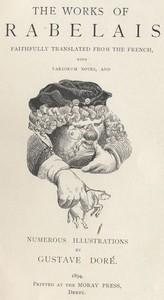
Rabelais's style fuses erudite references with scatological humor. Friar John advises Panurge to “solder well together the joints of the double-backed and two-bellied beast” and warns that “non-usage oftentimes destroys one's right.” The text is dense with classical allusions—Leander and Hero, Homeric and Virgilian lots—alongside invented terms like “onocrotalwise” and “hypogastrian lower sort of troglodytic people.” The translators often add footnotes (initialled 'M.' from the Maitland Club edition) to explain these references. Readers unfamiliar with Renaissance humanism may find the digressions challenging, but the physical comedy and verbal inventiveness remain accessible. The illustrations by Gustave Doré, though not excerpted here, would amplify this blend of the grotesque and the learned.
Because the excerpts cover only the first half of Book III, the outcome of Panurge's quest remains unknown. Readers should approach this volume as a self-contained comic inquiry into decision-making, rather than a straightforward adventure. The translation's 17th-century English rewards slow reading, especially where the translators coin new words or preserve Latin tags. Pay attention to the footnotes, which often clarify the period context or restore passages omitted by Motteux.
There’s something about Panurge’s endless second-guessing that reminds me of being young and unsure, mapping out every step before moving. I felt that same quiet ache reading about two chums figuring out their place at the academy—old questions of loyalty and nerve, wrapped in a gentler uniform. Dick Prescott's First Year at West Point; Or, Two Chums in the Cadet Gray — Reading Notes lingered like a hand on my shoulder.
Your answers remain private and are stored only in this browser.