About 314 minutes
Gargantua and Pantagruel, Illustrated, Book 4 — Background and Themes
Young Readers Enchanted Adventures
72,067 recorded words. 0 minutes difference from this book's estimate.
View Gutenberg source #8169
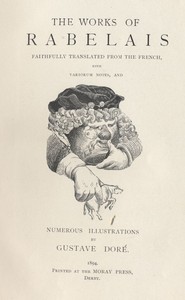
The catalog record for Gargantua and Pantagruel, Illustrated, Book 1 — Context and Discussion provides practical reading context through 72,008 words, 5 hr 14 min estimated reading time, and 9 detected text sections.
The text analysis averages about 26.0 words per sentence, while the detected sections provide another way to judge how the source is divided.
Project Gutenberg metadata also associates the work with “Giants -- Fiction,” connecting these edition facts with the source record’s subject description.
Explore this collection
These alternatives are selected using recorded categories and estimated reading time.
About 314 minutes
Young Readers Enchanted Adventures
72,067 recorded words. 0 minutes difference from this book's estimate.
View Gutenberg source #8169About 344 minutes
Young Readers Enchanted Adventures
78,960 recorded words. 30 minutes difference from this book's estimate.
View Gutenberg source #4777About 243 minutes
Young Readers Enchanted Adventures
55,800 recorded words. 71 minutes difference from this book's estimate.
View Gutenberg source #7963Search stored excerpts and compare books → Choose by your preferences →
Choices use stored catalog measurements. Estimates vary with reading speed. A shared category is a catalog label, not a claim that two books have the same argument or literary quality.
Search reads excerpt text stored with this catalog and links to its associated Gutenberg record. The connection is stored in the site database; this tool does not recheck that every excerpt is word-for-word identical to that external record. Excerpt search does not cover every chapter and does not verify historical publication dates.
Catalog snapshot checked: 2026-09-26. Coverage: 99 public books, 99 available source excerpts.
Calculated from edition completeness, EPUB availability, text structure and catalogue metadata. Not a user rating.
Total of 100 points, scaled to a 2.5-5.0 range. Editions with an empty description or a missing EPUB file are not scored.
Public-domain source text
The source text is kept in the dedicated reader, separate from this catalogue record and its commentary.
François Rabelais' Gargantua and Pantagruel, Illustrated, Book 1 is cataloged under 'Young Readers & Enchanted Adventures' and 'Giants -- Fiction,' yet the excerpts reveal a work far more complex than a simple giant tale. The narrative opens with a mock-heroic genealogy and a poem of 'extravagant Conceits,' immediately signaling its satirical intent. The catalog subjects, while technically accurate, understate the book's encyclopedic scope and its relentless parody of scholasticism, medicine, and social conventions.
The 'Young Readers & Enchanted Adventures' category suggests a child-friendly fantasy, but the excerpts show a work steeped in bodily functions and irreverence. Gargantua's birth is described as emerging from his mother's ear after she eats 'a huge deal of tripes,' and his early education includes the invention of a 'torchecul or wipebreech'—a wiping implement—which demonstrates his 'wonderful understanding.' The discourse of the drinkers and the detailed account of Gargantua's 'tippling, bibbing, and currying the can' further distance the text from conventional juvenile literature. These elements are not mere embellishments but central to Rabelais' critique of pedantry and his celebration of the physical.
While 'Giants -- Fiction' accurately describes the protagonists, the excerpts show that Gargantua's giant stature is less a fantasy element than a device for satirical exaggeration. His size allows Rabelais to lampoon human pretensions: Gargantua's horse is a 'huge great mare' that destroys oxflies, and he removes the bells of Notre-Dame to 'pay his welcome to the Parisians.' The giant's education under Ponocrates is a meticulous schedule of study, physical training, and music, presented with deadpan seriousness that mocks contemporary educational ideals. The catalog subject thus captures the literal presence of giants but misses their function as instruments of parody.
The excerpts reveal a text dense with references to classical authors—Pliny, Athenaeus, Galen, Aristotle—and detailed discussions of arithmetic, geometry, astronomy, and music. Gargantua's post-dinner studies include 'a thousand pretty tricks and new inventions' grounded in arithmetic, and he learns to play multiple musical instruments. This encyclopedic content aligns with the catalog's 'Fantasy fiction, French' only insofar as Rabelais uses the fantastical frame to embed genuine Renaissance learning. The narrative's digressions into the 'colours and liveries' of Gargantua and the significance of white and blue further demonstrate a playful erudition that transcends simple fantasy.
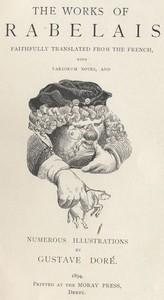
Readers approaching this edition should set aside expectations of a straightforward giant adventure. The catalog labels are starting points, not descriptions of the book's true character. Rabelais' work rewards attention to its layered satire, linguistic inventiveness, and scholarly allusions. The illustrations by Gustave Doré, though not excerpted here, complement the text's visual humor. Engage with the footnotes and the translators' preface to navigate the 17th-century English and the cultural references that enrich this enduring satire.
The rain kept drumming against the window while I lingered over Rabelais’ catalog entry, smiling at how “Giants — Fiction” undersells that vast, messy feast of language. That same evening, my hand drifted to a slim volume with an almost identical title about bracelets. Strange, how one borrowed thought leads somewhere wholly unexpected. The bracelets — Context and Discussion offered a quieter, more delicate kind of play, and the afternoon folded into itself, warm and unhurried.
Your answers remain private and are stored only in this browser.