About 314 minutes
Gargantua and Pantagruel, Illustrated, Book 1 — Context and Discussion
Young Readers Enchanted Adventures
72,008 recorded words. 0 minutes difference from this book's estimate.
View Gutenberg source #8166
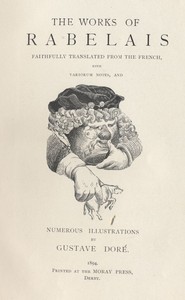
For Gargantua and Pantagruel, Illustrated, Book 4 — Background and Themes, the stored edition analysis reports 72,067 words, 5 hr 14 min estimated reading time, and 10 detected text sections.
The text analysis averages about 25.1 words per sentence, while the detected sections provide another way to judge how the source is divided.
Project Gutenberg metadata also associates the work with “Giants -- Fiction,” connecting these edition facts with the source record’s subject description.
Explore this collection
These alternatives are selected using recorded categories and estimated reading time.
About 314 minutes
Young Readers Enchanted Adventures
72,008 recorded words. 0 minutes difference from this book's estimate.
View Gutenberg source #8166About 344 minutes
Young Readers Enchanted Adventures
78,960 recorded words. 30 minutes difference from this book's estimate.
View Gutenberg source #4777About 243 minutes
Young Readers Enchanted Adventures
55,800 recorded words. 71 minutes difference from this book's estimate.
View Gutenberg source #7963Search stored excerpts and compare books → Choose by your preferences →
Choices use stored catalog measurements. Estimates vary with reading speed. A shared category is a catalog label, not a claim that two books have the same argument or literary quality.
Search reads excerpt text stored with this catalog and links to its associated Gutenberg record. The connection is stored in the site database; this tool does not recheck that every excerpt is word-for-word identical to that external record. Excerpt search does not cover every chapter and does not verify historical publication dates.
Catalog snapshot checked: 2026-09-26. Coverage: 99 public books, 99 available source excerpts.
Calculated from edition completeness, EPUB availability, text structure and catalogue metadata. Not a user rating.
Total of 100 points, scaled to a 2.5-5.0 range. Editions with an empty description or a missing EPUB file are not scored.
Public-domain source text
The source text is kept in the dedicated reader, separate from this catalogue record and its commentary.
Book IV of Gargantua and Pantagruel opens with Pantagruel setting sail to consult the Holy Bottle, but the narrative quickly veers into a series of episodic island encounters. The translation by Urquhart and Motteux preserves Rabelais's characteristic blend of erudite allusion and bawdy humor, yet the pace varies markedly: leisurely catalogues of curiosities give way to sudden, violent action. The storm in chapters 4.XVIII–4.XXII, for instance, shifts from mock-heroic description to urgent dialogue, while the later anatomy of Shrovetide (chapter 4.XXX) slows to a meticulous, absurd inventory. These changes in tempo are not merely stylistic; they underscore the tension between learned discourse and bodily chaos that runs through the work.
The storm sequence (chapters 4.XVIII–4.XXII) marks a sharp acceleration in narrative tempo. Earlier chapters amble through islands with leisurely catalogues—Pantagruel buys rarities, Panurge bargains for sheep—but the storm compresses time into a series of panicked exchanges. The prose shifts from descriptive expansiveness to staccato dialogue: Panurge’s cries of fear and Friar John’s oaths create a rhythm of interruption. The pilots’ abandonment of the ship (chapter 4.XX) is rendered in short, declarative sentences, contrasting with the earlier, more elaborate descriptions of island customs. This change in pace mirrors the loss of control experienced by the characters, as the sea overwhelms both their plans and their composure.
In chapter 4.XXX, Xenomanes anatomizes Shrovetide in a long, methodical list that slows the narrative to a near standstill. Each bodily part is compared to a mundane object: the brain is “like the left cod of a he hand-worm,” the stomach “like a belt,” the lungs “like a prebend’s fur-gown.” This catalogue is not merely comic; it imposes a pseudo-scientific order on a grotesque figure, parodying contemporary anatomical texts. The pace here is deliberate, almost incantatory, as if the text itself is performing a ritual dissection. The shift from the storm’s urgency to this static enumeration highlights Rabelais’s ability to modulate tempo for satirical effect.
Panurge’s language undergoes a marked shift in the storm chapters. Earlier, he is voluble and cunning—bargaining with Dingdong, devising schemes—but during the storm, his speech becomes fragmented and fearful. He cries out, “Quid juris?” and “Shankers and buboes!” His earlier confidence dissolves into a series of exclamations and pleas. This change in voice is not a development of character but a situational response; Panurge remains essentially self-interested, but the crisis strips away his rhetorical flourishes. The contrast between his earlier loquacity and his later stuttering panic underscores the storm’s role as a leveling force, reducing even the most articulate to inarticulate fear.
Readers attentive to shifts in pace will find that Rabelais uses tempo as a tool of satire: the leisurely island visits mock the traveler’s curiosity, while the storm and the anatomy expose the fragility of human pretension. The translation’s archaic diction and rhythmic variety reward reading aloud, especially in the storm’s dialogue and the catalogue’s litany. Approach Book IV as a series of tonal experiments rather than a unified plot; the pleasure lies in the sudden transitions from learned digression to bodily farce.
Somewhere between the storm and Shrovetide’s brittle anatomy, I found myself thinking of quieter ruins—how Gargantua and Pantagruel mocks our bluster, while Satan's garden — Context and Discussion lingers on what we hide when the wind drops. Both feel like old friends who’ve seen me panic, then laugh, then look away. I keep returning, wistful for that honesty.
Answer a few questions and save a private reflection on this device.